
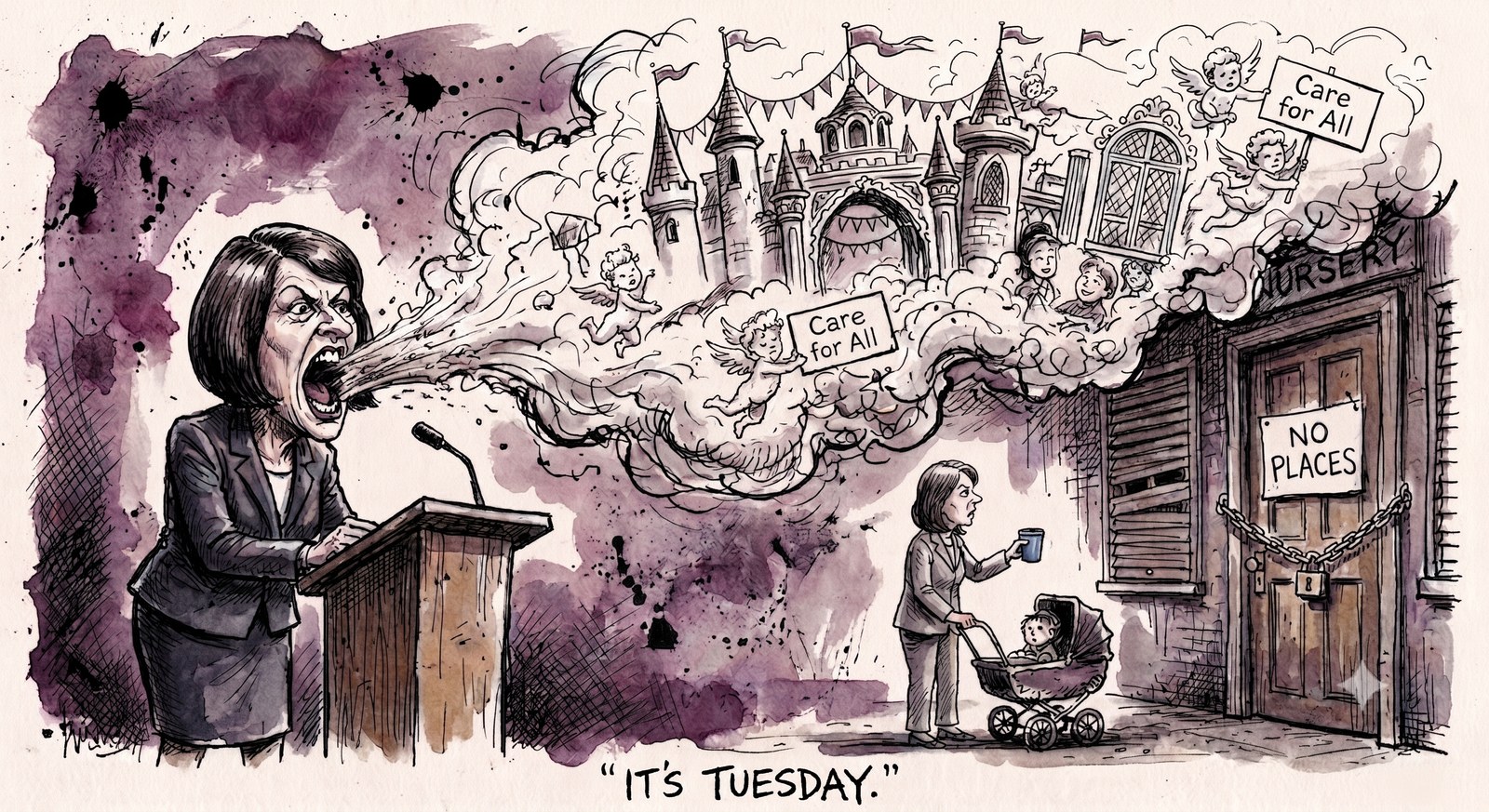
A nursery is one of those things which can be built very quickly in a speech.
One begins with opportunity. Then one adds fairness, hope, skilled professionals and perhaps a child looking thoughtfully at a wooden puzzle. Before long, universal childcare has appeared, fully staffed and within walking distance of everybody who needs it.
This is a great advantage of speeches.
Actual nurseries take rather longer. They require rooms, people, money, regulations, tiny chairs and somebody willing to discover what has happened to the blue cup. They must also exist on Tuesday, which is the day the parent requires them, rather than on Thursday, when the parent has been offered a place.
Bridget Phillipson's speech at Ruskin College put early-years education at the centre of a larger argument about freedom and opportunity. Her case was that education does not begin suddenly at four, as though the child had spent the previous years waiting outside the school gates for intellectual life to commence. Children begin learning at once — language, confidence, patience and the difficult business of allowing another person to hold the red pencil. Those who receive excellent early education begin school with advantages which do not disappear merely because everybody is later given the same exercise book.
This matters to children. It matters equally to their parents, who must somehow combine raising them with earning enough to continue raising them.
Phillipson drew what she called a "direct line from affordable childcare to the economic empowerment of women". The line exists, though not always in the sense preferred by mapmakers. It may begin at home, travel to a nursery in the opposite direction from work, stop at a railway station, double back for a forgotten comfort blanket, and arrive at the office twenty minutes after the meeting has begun.
A parent may be perfectly capable of working and entirely willing to work, yet unable to do so because the nursery has no place, closes too early or costs more than the work brings home.
This is generally described as a childcare problem. It is also a workplace problem, although the workplace has become very skilled at standing slightly to one side while the matter is discussed.
The state says that funded hours are available. The nursery says the funded rate must cover the room, the staff and everything else required to prevent the room becoming merely a room full of children. The employer says the meeting begins at half past eight.
The parent is then congratulated on being flexible.
Universal early-years education would improve this arrangement. It would treat childcare not as a private inconvenience attached to parenthood but as part of the country's educational and economic machinery — helping children whose families cannot currently buy the best start, keeping parents in work, and sparing employers the cost of losing experienced people because the daily sum no longer works.
But national systems are not assembled before breakfast. Parents still have work on Monday.
This is where employers enter the picture, though some may be surprised to find themselves in it.
Employers already provide the things which make work possible: computers, desks, telephones, training. They choose offices near railway stations because an office nobody can reach is considered inconvenient. Yet childcare is treated as a pleasant extra, alongside fruit on Wednesdays and a discount at a gym nobody has time to visit.
For a parent, a nursery place is not in the same category as fruit. Without it, the job may not happen.
A workplace nursery need not be a little building next to reception with the finance director reading stories at lunchtime. The tax rules already allow qualifying arrangements to operate elsewhere, provided the employer is genuinely involved in financing and managing the provision. That last part is important. It is not enough for an employer to point at a nursery several miles away and announce that a partnership has taken place. A partnership involves doing something: helping to finance places, participating in management, working with a nursery to make provision more affordable for its people.
Done properly, the arrangement helps three parties. The parent gains childcare which makes work possible. The employer keeps a person it has already trained. The nursery gains a partner with an interest in its survival.
There are worse arrangements.
Employer-supported childcare will not create universal provision by itself. It helps people connected to employers, and a national system must also serve children whose parents are not working, cannot yet enter work or live where provision is scarce. The state cannot hand the matter to businesses and wish everybody success.
Nor should employers wait for a perfect national system before doing anything themselves. There is a habit in public life of treating an incomplete solution as though it were no solution at all. A workplace nursery cannot repair every part of the childcare market. Neither can a railway station repair the transport system, but one is pleased to find it where the train stops.
Phillipson said that early-years provision must support parents as well as children. This sounds obvious, which is often a sign that it has not yet been arranged. A child's education, a parent's job and a nursery's finances are discussed in separate rooms by people carrying separate folders. The parent must make all three folders agree.
This is why Halo exists. Employers need not wait for universal childcare before accepting their part in the matter. They can work with nurseries now, make provision more affordable for their people and support the settings on which working communities already depend. Not an alternative to the larger ambition — something useful to do while pursuing it.
One day, perhaps, early education will be regarded as naturally as primary school: available, properly funded, staffed by professionals whose importance is reflected in their treatment. Until then, speeches will continue to build nurseries rather faster than the country does.
The speech may describe the future.
The parent still needs somewhere to leave the blue cup on Tuesday morning.